May 6, 2008
Dear Coalition Friends:
The Smithsonian Institution has decided not to seek a public-private partnership to restore the Arts & Industries Building on the Mall, as reported in The Washington Post today.
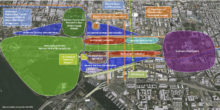
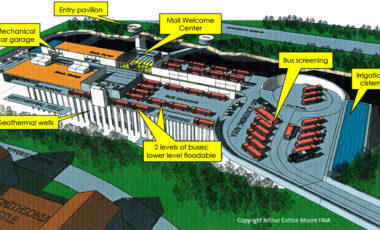
We have been advocating that a portion of this building should be used for a Welcome Center for the Mall and the city. We hope to keep that idea alive no matter what the future holds for the building.
Note that one reason for the Smithsonian's decision is that Congress is creating a commission to study the feasibility of a Latino American museum and A&I is a potential location.
For more on that Latino museum story--and a quote from Coalition Chair Feldman about the need for an expanded Mall--see the story from The Los Angeles Times below.
THE WASHINGTON POST
By Jacqueline Trescott
Tuesday, May 6, 2008; C01
The Smithsonian Board of Regents voted yesterday to stop looking for help from an outsider to rejuvenate the historic Arts & Industries Building, the massive, shuttered exhibition hall at the heart of the National Mall.
Last November the Smithsonian solicited ideas for a public-private partnership to save the building. It also conducted a staff survey about how the building could be used. The public submitted 11 proposals and the staff came up with 2,000 ideas.
But, after a tour of the building Sunday night, the regents decided it should remain a Smithsonian-controlled edifice and operation.
Roger W. Sant, chairman of the regents' executive committee, said the decision was based on several factors. The institution is about to get a new leader: G. Wayne Clough, the president of Georgia Tech, will take over as Smithsonian secretary in July. Also, the Smithsonian is planning a national capital campaign, and some funds will be targeted for a backlog of repairs. And a commission is engaged in a two-year feasibility study on the concept of a Latino American museum, and Arts & Industries is a possible site.
"Ultimately we decided that the Smithsonian should retain control of this historic landmark building," Sant said. The decision doesn't preclude future partnerships on amenities such as a restaurant but rules out outside proposals that have long-term leases.
The Smithsonian closed the building to the public in January 2004 after years of falling roof debris. Several studies said that visitors and staff were at risk because of the deteriorating conditions. The building has been one of the symbols of the Smithsonian since 1881, when it opened as the first national museum.
For years, architectural historians, preservationists and some members of Congress howled about the lack of repairs or concrete plans for its future. The Smithsonian is now spending $200,000 a year on maintenance of the building. The estimate to repair just the shell is about $65 million. Sant said there was no timetable for making a decision about Arts & Industries. "It has been closed for four years and we are getting anxious about it," he said.
In other developments, the regents decided yesterday that they would keep the size of the governing body at 17, but the added new responsibilities for all regents, including the chief justice of the U.S. Supreme Court. Justice John G. Roberts Jr. will be a non-voting adviser to the three-member executive committee. Roberts has agreed to pressure the next U.S. vice president to be an active member of the board. That would be a sharp change, as neither Al Gore nor Dick Cheney attended many of the meetings; the vice president is an ex officio member of the board.
* * * * * *
THE LOS ANGELES TIMES
The House votes to create a commission to look into building the National Museum of the American Latino in the nation's capital.
By James Hohmann
April 30, 2008
WASHINGTON - Four years ago, a museum celebrating the history and culture of Native Americans opened at the east end of the National Mall. Within a decade, one honoring the contributions of African Americans will be erected on the west end, near the Washington Monument. Yet Latinos, the nation's largest and fastest-growing minority, have no museum of their own in the nation's capital.
But the National Museum of the American Latino came one step closer to reality Tuesday when the House, by a vote of 291 to 117, approved legislation that includes creation of a commission to study the feasibility of building such a facility.
There's no timeline for construction. Neither the museum's location nor the scope of its collection has been determined. Still, a host of groups praised the vote.
"Latinos were a part of American history before the landing at Plymouth Rock," said Arturo Vargas, executive director of the National Assn. of Latino Elected & Appointed Officials. "This is going to be a long process, but Latinos aren't going anywhere, and we're going to see this through."
The measure is included in a larger bill on natural resources that passed the Senate, 91 to 4, this month. It authorizes creation of a bipartisan 23-member commission that will spend $3.2 million over two years to come up with recommendations and sponsor a conference where interested individuals or groups can submit ideas and develop a fundraising plan.
The driving force behind the proposal is Rep. Xavier Becerra (D-Los Angeles), who introduced the plan almost five years ago. "Like any good idea in Washington, it takes a few years to percolate to the top," he said. "It's a good idea whose time has come."
The push for the new museum comes in the midst of a continuing debate about the future of the [National Mall], the iconic two-mile stretch from the Capitol to the Lincoln Memorial that includes museums, memorials and green space. Prompted by concerns that the mall was becoming too cluttered, Congress in 2003 designated land where future construction is prohibited.
The National Coalition to Save Our Mall welcomes the Latino museum commission as long as it takes the time for careful analysis with public comment. The construction should be part of a rethinking about the grand plan of the mall, said Judy Scott Feldman, the coalition's president.
"The National Mall, which was intended since 1791 as a public open space, a public park, a place for the people, has increasingly become a memorial and museum park," Feldman said. "We have to allow it to continue to evolve without destroying the historic mall."
The commission also will recommend whether the museum should stand alone or become part of the Smithsonian Institution, which includes 19 museums, nine research centers and the National Zoo. The ultimate decision on that issue will be made by Congress, said Linda St. Thomas, a Smithsonian spokeswoman.
Both the National Museum of the American Indian and the National Museum of African American History and Culture are part of the Smithsonian. Vargas says he wants the Latino museum to have the added cachet that comes with being affiliated with the Smithsonian.
"For it not to be would raise serious concerns from the community as this process develops," he said.
Becerra said the bipartisan coalition that sponsored the measure declined to tell the commission what it preferred. That way, he said, experts can come up with the best proposal. "Good minds and good will to come up with some good answers," he said.
Maggie Rivas-Rodriguez, director of the U.S. Latino and Latina WWII Oral History Project at the University of Texas in Austin, said Latinos should be included in more Washington exhibitions.
"It's equally important to look at how Latinos are represented in the other national museums," she said. "It's just been ignored for too long."
james.hohmann@latimes.com
See also http://www.miamiherald.com/news/breaking_dade/story/521067.html
Back to the top
|