| | |
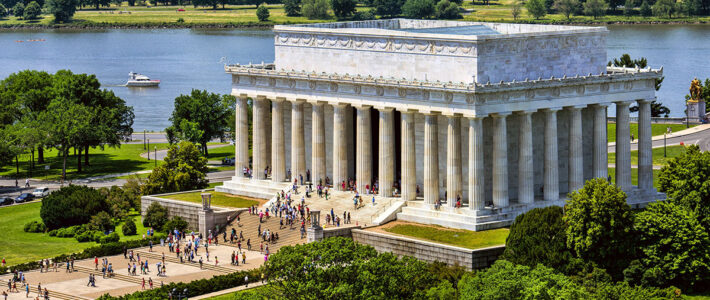
| February 8, 2008 Dear Coalition Friends, For your consideration... See below a commentary on the controversial Vietnam Memorial visitor center from Bloomberg's architecture critic James Russell. Also, a related piece from journalist Steven Knipp, "Because Americans Know Little History, Washington DC's Building Visitor Centers. Really" at http://hnn.us/articles/46683.html and below. Clearly, a better way to tell our nation's story on the Mall is needed. Right now politics reign. The threats to the Mall's integrity are, if anything, increasing. As our readers know, the National Coalition to Save Our Mall has been advocating a "Third Century Mall," an intelligent, forward-looking vision that expands the Mall's capacity to tell our nation's ongoing story and provide a welcoming, exciting public open space for visitors and DC residents alike. To whom shall we entrust that task? Federal government? DC government? The Coalition proposes an independent commission of committed, thoughtful visionaries, in the tradition of Pierre L'Enfant in 1791 and the McMillan Commission of 1901-1902, to lead the way. Click here to learn more http://www.savethemall.org. Inane Visitor Center Will Wreck Maya Lin's Vietnam MemorialCommentary by James S. Russell Feb. 1 (Bloomberg) -- Is it time to say goodbye to the Vietnam Veterans Memorial in Washington? If a planned visitor center is built, it will diminish the evocative power of Maya Lin's great 1982 work -- by trying to explain it. The project design by New York's Polshek Partnership, architects of the inspiring Clinton Presidential Library, is currently being reviewed by numerous regulatory bodies charged with protecting the National Mall. Yet because of wording in the enabling legislation, only Congress can actually stop this juggernaut. Jan C. Scruggs, the veteran who undertook the original effort that resulted in Lin's memorial, leads the sponsoring Vietnam Veterans Memorial Fund, which hopes to raise as much as $100 million for the center. Its intentions are honorable if misplaced. As the Vietnam War grows more distant in time, fewer of the memorial's 4 million annual visitors have a direct connection to the conflict. Volunteers field more questions about the war and its significance. The exhibition concept by Ralph Appelbaum Associates, whose firm developed the Holocaust Memorial Museum's brilliant exhibitions, will put faces to the names on the wall and offer their life stories. The center will display the heart-rending artifacts that have been left at the wall and tell the story of the war. Lin's insight, though, was to remove the visitor from the distractions of both history and the moment. You focus only on the names of the fallen and their sheer numbers. The columns of names grow as you descend. That's all there is, and that's all there needs to be. Individual Sacrifices Lin made us see what the political battles around the Vietnam War obscured: the sacrifice made by real people who trusted their leaders, whether or not those leaders deserved their trust. Humanizing the individuals depicted on the wall is appealing but does little to add to our understanding of the conflict. The planned timeline of the war, by introducing its controversial history and ultimate failure, would inevitably distract us from those reproachful names on the wall. A site-selection study couldn't find a suitable way to integrate the center with the wall -- clearly signaling what a misbegotten enterprise this is. So the visitor center has been hidden behind the memorial, across Henry Bacon Drive on a flat, grassy triangle. It's like a relative you're too embarrassed to introduce to guests. Constrained Design The timid design, by James Polshek and Thomas Wong, was largely preordained by the politically motivated constraints under which it was commissioned. Absurdly, it was supposed to lie entirely underground and essentially disappear. That was a political compromise to avoid sullying a sanctified landscape that is the chief repository of national identity. However politically tidy, this notion is an architectural impossibility: Even buried buildings don't disappear, and if the center's purpose is meaningful, it needs to be visible and expressed. To their credit, the architects wouldn't settle for a sad little lobby kiosk. They invite the visitor by folding the lawn down to a sunken entrance court accessed by a switchback ramp. That court overlooks a reflecting pool occupied by high horizontal glass tubes in a staggered alignment. They're meant to look like display cases that have slid out from under the structure's turf roof. But they read like the urn-holding walls in a mausoleum. I'm glad the memorial provokes curiosity about the war and its effects, yet whether that curiosity must be sated on the Mall itself remains questionable, given the easy access to authoritative resources on the war and those who fought in it. More Visitor Centers Worse, it will set off a domino effect (to use a Vietnam- era expression) in which each major memorial will be deemed worthy of its own interpretive center. After all, how deep is the average visitor's knowledge about the Korean War or even Lincoln, whose gigantic temple looms above the Vietnam site? Congress keeps authorizing memorials even though it has agreed that the Mall is a completed work of art. (One to Martin Luther King Jr. and a museum of African-American history and culture are in the pipeline.) Then they swear off future additions. But there's always more. The Mall is coming to resemble the Gettysburg battlefield. After the Civil War, it got littered with obelisks and statues, their grandiosity determined not by achievement but by cash raised. Similarly, what gets built on the Mall increasingly reflects political acumen and fundraising ability. After Gettysburg, the military banned memorials that glorified individuals, not national values. The nation should follow suit on its own most sacred landscape. (James S. Russell is Bloomberg's U.S. architecture critic. The opinions expressed are his own.) To contact the writer of this story: James S. Russell in New York at jamesrussell@earthlink.net *************************** George
Mason University's Because Americans Know Little History, Washington DC's Building Visitor Centers. Really.By Steven Knipp Mr. Knipp is a DC based journalist working as Washington correspondent for a major Asian-based newspaper. Everyone laughed in 2001 when, at a Washington correspondents' dinner, President Bush asked the question: "Is our children learning?' But, bumbling language aside, it's a good question. In science and technology, there's no uncertainty that today's kids are indeed keeping up. They can learn to use virtually any electronic device from a just released laptop, to an iPhone or PC-mounted camcorder in a matter of minutes. For history, however, the news is not so good. In fact it's bad. Very bad. I'm not basing this judgment on any detailed academic study or in-depth survey, but merely on what I see and hear almost every day as a resident of Washington DC. As the national's capital, the District of Columbia is the beating heart of American history. This city on the Potomac is literally America's metaphysical attic, both the place where we physically store our most important documents, and the sun-dappled setting we've chosen to honor, in bronze and granite and marble, the ideals of the great and the good in American history. And it's for that reason, that each year hundreds of thousands of high school kids come here, every spring and every autumn, from Boston and Chicago and Denver, and San Francisco. It is a statistical fact that we Americans remain in school longer than any other society in history, entering kindergarten at five and often only get catapulted out of academia a full quarter of a century later. Despite that impressive educational marker, whenever I hear young people open their months when visiting Washington, more often than not, they come across sounding like ignoramuses. Recently, while walking near the wonderfully sprawling open-air monument to President Franklin Roosevelt, I happened to overhear two high school boys who had just been poured out of a bus. They were literally asking themselves why they were visiting this place. One said to the other: "So, who's this 'FDR guy?" It was painfully obvious that these two real life versions of Dumb & Dumber had never been taught about the Great Depression, and how Roosevelt had helped created a whole raft of innovative social programs to pull this county back to prosperity. Considering that a recent report revealed that many of today's high school kids think that America fought on the side of Germany during the Second World War, there's a good chance that these same two bird brains would also have no knowledge about FDR's central role in defeating both the Nazis and the Japanese Empire. In 2001, the U.S. Department of Education reported that nearly six out of 10 high school seniors knew so little about their own nation's history that many are basically historically illiterate. And things have only gotten worse since then. Today's students routinely fail to know in which century the Civil War was fought, or even why it was fought. Ask a gaggle of high school seniors to explain, even briefly, exactly who any of the following were: Woodrow Wilson, Sam Houston, Emma Lazarua, Jack London, Thomas Paine, Adlai Stevenson, James Baldwin, Ike Eisenhower, John Glenn or Daniel Webster -- and the odds are good that none will know any of them. Official Washington is now reacting to this distressing situation. No, not by pouring more money into American history education, but by throwing up steel and stone remedial learning centers in the guise of "visitor centers." The first one, costing $110 million, opened a year ago at Mount Vernon, George Washington's charming Potomac River estate just south of the capital. Decades ago, when high school kids visited Mount Vernon, they had been well briefed by their teachers about the Great Man, his life story, and how his example of selfless service and his strong personal support of democratic rule set a sterling example for all other presidents to follow. Today's visitors seem about as well informed about this American icon as Borat is about America in general. "Some people," Emily Dibella, a PR officer at Mount Vernon, told the Washington Post, "think Washington fought in the Civil War." Another visitors center will be built at the Vietnam War Memorial. The Memorial itself was designed 25 years ago by the then 21 year old Yale University student Maya Lin. Once controversial, today it is the single most visited destination in Washington, an uncomplicated but stunningly vivid testament to the aching toll of that war, which cost 58,000 American lives. The trouble is, today, too few people know much about the war itself, hence the 25,000 square foot visitors center which will include a movie theater to explain to visitors what they apparently were never properly taught in schools. The cost: $100 million, more than ten times the original cost of the memorial itself. Early this week, I again happened to be strolling on the National Mall, this time crossing between the great Greek barn that is the Lincoln Memorial, and the glinting waters of the Reflecting Pool. Just as I arrived, a mammoth tour bus pulled up, and a tidal flow of teenagers poured out onto the Mall. As I followed this stream towards the steps of the Reflecting Pool, one of the older boys started to stammer something, some remembered fact perhaps, some ingot of information jarred from a history class? Maybe it was about George Washington? Or perhaps it was to do with Mr. Lincoln, and his crucial role in tying to heal a nation which had been torn tragically apart by the Civil War? Possibly it was a reference to Martin Luther King's historic and stirring "I have a dream speech" given on this very spot in 1963? Alas, it was none of the above. Finally, with obviously immense effort, the boy managed to pull his thoughts together and utter what contemplation this extraordinary American vista had brought to his agitated adolescence brain. "Look everybody," he shouted with glee, "This is where they made that Forrest Gump movie!" |
|
Copyright © 2004 National Coalition to Save Our Mall Inc. All Rights Reserved |