National Coalition to Save Our Mall
view  view         

Home  •   Search  •   Newsletter/Archive  •   Contact Us   


DONATE

LETTER FROM THE PRESIDENT
   October 30, 2007

HISTORY AND RESOURCES
• Mall Maps
• Illustrated History
• Future of the Mall VIDEO
• 1902 McMillan Commission   Report

NATIONAL MALL THIRD CENTURY INITIATIVE

NATIONAL MALL CONSERVANCY

ANNUAL REPORTS
• 2006 Annual Report (PDF)
• 2005 Annual Report (PDF)

GREAT MOMENTS
PHOTO GALLERY
• Who's in Charge?

THE MALL CHRONICLES
• Media Coverage
• Analysis
• Coalition Testimony
• Letters

THE WWII MEMORIAL
• WWII Memorial Archive

WASHINGTON MONUMENT
• Washington Monument Archive

U.S. CAPITOL

THREATS & TREATS
ACT NOW
• What You Can Do
• Contribute

WHO WE ARE
WWII Veterans
PRESSROOM
Detailed Search


EAST AND WEST POTOMAC PARKS
HISTORIC DISTRICT
REVISED NATIONAL REGISTER OF HISTORIC PLACES NOMINATION
(Prepared for the National Park Service, National Capital Region, by Robinson & Associates, Inc. in
association with Architrave P.C. Architects)
16 July 1999


The following are direct quotations relevant to the Rainbow Pool, which is the proposed site for the World War II Memorial. They indicate that the Rainbow Pool

  • is a "contributing site" to the Lincoln Memorial;
  • that it was conceived and designed by members of the McMillan Commission (see p. 73);
  • that the vistas through and around it are contributing;
  • and that its significance has increased with the social and political activities that have taken place there, especially civil rights.

Section 7

P. 1 This revised nomination has been prepared to supplement the original nomination for the East and West Potomac Parks Historic District, which was prepared in 1972, and was accepted into the National Register of Historic Places on November 30, 1973. The revised nomination was commissioned by the …National Park Service in 1996

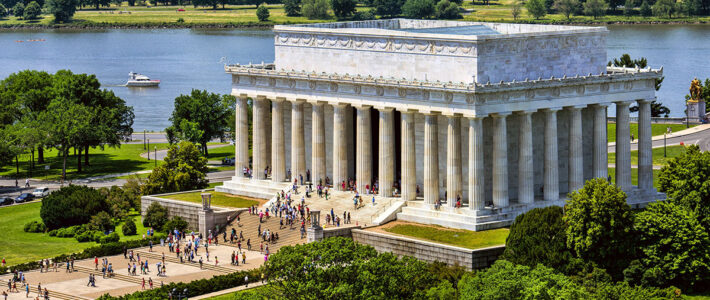
P. 15 The Lincoln Memorial was individually listed in the National Register of Historic Places in 1981. The Lincoln Memorial and the Lincoln Memorial Grounds contribute to the East and West Potomac Parks Historic District, based on National Register Criteria A and C in the areas of Architecture, Art, Landscape Architecture, and Commemoration….The Lincoln Memorial has become one of the nation’s best-known and well-loved monuments.

The Reflecting Pool (Contributing Site) and Rainbow Pool (Contributing Site)…are integral components of the designed historic landscape of the Lincoln Memorial. The McMillan Plan of 1901-02 called for a long reflecting pool, or canal, to provide a formal water element connecting the Washington Monument and Lincoln Memorial. This element, as implemented by the Reflecting and Rainbow Pools, is one of the singularly important features of the extended vista that the McMillan Plan created on this grand axis.

P. 16 Together, the Reflecting Pool and the smaller Rainbow Pool form a panel of water more than 2,000 feet long, and their geometry provides a striking feature of the ground plane as viewed from the air. [T]he conceptual design for the two pools (as well as the memorial) was prepared by McMillan Commission member Charles F. McKim. The interpretation of McKim’s conceptual design can be credited to Lincoln Memorial architect Henry Bacon working directly with Commission of Fine Arts member Frederick Law Olmsted, Jr.

The Reflecting Pool and Rainbow Pool contribute to the East and West Potomac Parks Historic District …The two pools are integral aspects of the McMillan Plan, the landmark City Beautiful plan for the city of Washington.

The double rows of Dutch Elm Trees (Contributing Site) ….are also a defining feature within the McMillan Plan landscape.

P. 42 Among the defining elements of West Potomac Park are the vast unimpeded vistas. Vistas connect the broad greensward, the distant monuments, the Potomac River, and the low skyline of the city. The strongly prevalent axial views and vistas are the essence of the McMillan Plan for the parks.

The following primary views and vistas in West Potomac Park are recognized by the National Register [as] significant, and add to the qualities of the historic district.

P. 43 The Vista from the Lincoln Memorial to the Washington Monument was one of the most important elements of the McMillan Plan of 1901-02, as it extended the formal vista to the east (between the Capitol and the Washington Monument) a major distance to the west to connect the Washington Monument and the Lincoln Memorial. This vistas is most impressive viewed from the steps of the Lincoln Memorial across the length of the Reflecting Pool and the Rainbow Pool, to the Washington Monument. Important features of this vista are the double rows of Dutch elm trees on each side of the Reflecting Pool and reflections in the clear water of the pool.

Section 8

P. 57 The lands included in the East and West Potomac Parks Historic District ….are remarkable urban spaces, with a singular history and a singular national significance as part of the monumental core of the nation’s capital.

East and West Potomac Park are significant in the areas of Architecture, Art, City Planning, Commemoration, Engineering, Entertainment/Recreation, Landscape Architecture, Politics/Government, Social History, and Transportation for the period of 1882-1997.

P. 58 City Planning - The treatment and use of West Potomac Park was directly addressed as part of the McMillan Plan of 1901-02, the country’s first major manifestation of the City Beautiful movement’s ideals of order, hierarchy, and formality in grand, civic spaces. This landmark plan, intended to restore L’Enfant’s vision to the city of Washington, still has resonance within the city today. Besides the L’Enfant and McMillan Plans, the parkland has been shaped by a succession of later plans, most notably the Skidmore, Owings, and Merrill 1965 master plan for the National Mall.

Entertainment/Recreation – An 1897 Act of Congress set aside the two parks for recreational use by residents and tourists alike. The McMillan Plan of 1901-02 reserved the interior of West Potomac Park for passive recreation, and spaces for active recreation were later sited on the park’s fringes….Both parks have served as major recreational facilities for the city in the ensuing years.

Section 8 Page 59

Landscape Architecture – West Potomac Park has become one of the nation’s most important designed landscapes. Several of the park’s defining landscape features can be directly attributed to Frederick Law Olmsted, Jr., one of the most famous American landscape architects of all time. As a member of the McMillan Commission, the Commission of Fine Arts, and the National Capital Planning Commission, Olmsted, Jr., was intimately involved in shaping the landscape of West Potomac Park.

Social History – West Potomac Park has become a continued venue for significant national social gatherings and demonstrations. In particular, the Lincoln Memorial has become an icon in the civil rights movement. It is best known as the location of such defining moments as Marian Anderson’s 1939 Easter Sunday concert, and Martin Luther King, Jr.’s "I Have A Dream" speech in 1963. Also, the nation’s annual Fourth of July celebration centers on West Potomac Park and the National Mall. Numerous other events add to the national impact that gatherings in this space have made.

P. 64 [The McMillan Plan] addressed the treatment and use of East and West Potomac Parks with some specificity, stating that: "The mall of the original city will be connected with the new Potomac Park and form an integral and important part of an extensive park area…..[West Potomac Park will] be forever held and used as a public park, for the recreation and pleasure of the people….The park will be transformed into a thing of beauty by the landscape gardener’s art.

P. 66 The McMillan Plan was clearly responsible for establishing (or in some cases, re-establishing) the remarkable monumental civic spaces that are defining characteristics of Washington today….It is recognized today as the first comprehensive plan of the American City Beautiful movement, the Beaux-Arts tradition as applied to city planning.

P. 67 The McMillan Plan has been called a permanent version of the 1893 Chicago World’s Columbian Exposition’s "ideal of America as a new democratic Rome"…

P. 72 A number of events significant in the history of the civil rights movement have taken place at the Lincoln Memorial. On April 9, 1939, contralto Marian Anderson gave an Easter Sunday concert on the steps of the Lincoln Memorial, before an integrated crowd of 75,000 people….On August 28, 1963, Martin Luther King, Jr., delivered his "I Have a Dream" speech before a crowd of 400,000 people…On December 28, 1971, 87 members of Vietnam Veterans Against the War were arrested for their attempt to seize and seal off the memorial. In the past twenty years, protestors have demonstrated…on a wide variety of issues, such as abortion rights, fetal rights, gay rights, housing discrimination, world hunger, the plight of soldiers missing in Vietnam, embassy hostages in Iran, victims of drunk drivers, AIDS, and for the freedom of the people of numerous countries. These events have provided an additional layer of significance to an already important national memorial.

P.73 The Reflecting Pool (Contributing Site) and Rainbow Pool (Contributing Site), conceptually designed by Charles F. McKim, and further refined by Henry Bacon and Frederick Law Olmsted, Jr., were both prominent features of the McMillan Plan of 1901-02. … The Rainbow Pool, built at the eastern end of the Reflecting Pool, was equipped with jets that created a rainbow effect in natural sunlight when water was forced through them. Over the years, these two basins have been used for recreational purposes such as wading, ice skating, model boat racing, and fly-casting contests.

P. 83 During her husband’s administration (1964-68), Lady Bird Johnson undertook a number of projects in the two parks as part of her formidable Beautification Program.

The landscape of West Potomac Park was reevaluated in 1964, when the architectural firm Skidmore, Owings, and Merrill, with landscape architect Dan Kiley serving as landscape consultant, was retained to draft a new master plan for the National Mall…The 1965 ..master plan proposed to redesign the axial portion of West Potomac Park, by lengthening the Reflecting Pool, which was to terminate at an "island lookout platform" at Seventeenth Street.

P. 84 The 1965 plan "also called for planting additional trees to reduce the Mall’s greensward from the proportions established by the McMillan Plan at the start of the century"….This facet…was never implemented, as members of the Commission of Fine Arts felt that the existing proportions of green space were appropriate. One important aspect of this plan was the replacement of the inner drives of the Mall and West Potomac Park with gravel walks, which were solely designated for pedestrians, and not for parked cars.

P. 85 The Constitution Gardens (Contributing Site) project …[d]esigned in the early 1970s by the architectural firm Skidmore, Owings, and Merrill…was completed and presented to the nation as a Bicentennial gift in 1976….Owings…hired David Childs…to design the park.


CULTURAL LANDSCAPE REPORT
WEST POTOMAC PARK
LINCOLN MEMORIAL GROUNDS

National Capital Parks Central
August 1999
Part 1: Site History, Analysis and Evaluation and Design Guidelines

The following are direct quotations from this report on the Lincoln Memorial Grounds relevant to the Rainbow Pool, which is the proposed site for the World War II Memorial. They provide

  • the history of the site’s design by Charles McKim and Frederick Law Olmsted, Jr., among others;
  • features "contributing" to its historic status, including its use as a public forum, its use for passive recreation, the views and vistas, the open grassy areas around the pools, and the concrete paving around the Rainbow Pool;
  • criteria for its designation in the National Register ; and
  • guidelines for evaluating future development, which state that "Future commemorative features should be located in the Lincoln Memorial study area only if they will have a minimal impact on the historic setting."

P.3 This cultural landscape report will not only assist park managers, but also guide the Commission of fine Arts and other preservation groups in their efforts to manage and preserve the historic designed landscape of the Lincoln Memorial for the future.

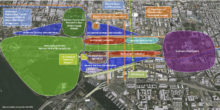
P.7 Map of Lincoln Memorial Grounds (including Reflecting and Rainbow Pools)

P.8 These guidelines are not intended to be treatment alternatives, but should be considered when determining what is appropriate or inappropriate for the historic designed landscape surrounding the Lincoln Memorial. The selection of new sites for monuments such as one for World War II Veterans and one to Martin Luther King, Jr., also influenced our efforts to provide a documents useful to park management in their decisions.

P.16 [Re. The McMillan Plan] The western end of the extension of the Mall axis was designed mostly by [Charles] McKim. ….[who] located the site for a memorial to Lincoln that would be complemented by a pair of basins, one essentially oval and another that had a long, cruciform shape. The reflecting basins, which would also contain several fountains, were set in lawn that was flanked by large groves of deciduous trees.

In 1910 President Taft created the Commission of Fine Arts (CFA) to oversee and guide the implementation of the McMillan Commission’s proposals. Daniel Burnham and Frederick Law Olmsted, Jr. were among the first to serve on the Commission of Fine Arts.

P.18 …Henry Bacon, a protégé of Charles McKim,…summarized best the appropriateness of the site in West Potomac Park in his statement on the overall design intent.

    "…I believed that the site in Potomac Park was the best one for a monument to Abraham Lincoln…we have at one end of the axis [of the Mall] a beautiful building which is a monument to the United States Government [the Capitol]. At the other end of the axis we have the possibility of a Memorial to the man who saved that Government and between the two is a monument to its founder. All three of these structures, stretching in one grand sweep from Capitol Hill to the Potomac river, will lend, one to the others, the associations and memories connected with each, and each will have its value increased by being on the one axis and having visual relation to the other."

P.35 Re. The Rainbow Pool. …The fountain for this pool was designated the "Rainbow Fountain" in October 1924, when during a trial run just before its dedication a rainbow formed above the fountain’s spray…the fountain made a "hazy vista" through which to view the Washington Monument and the Lincoln Memorials….In 1924, an inspection of the fountain by members of the Commission of Fine Arts resulted in the following observation and objection: too many spouts and the "playing" fountain obstructed the view of the Lincoln Memorial from 17th Street. Cf. P. 99 ..in 1990 some of the nozzles were replaced with a straight head type. It is unknown if this has altered the jet display that was originally approved by the CFA in the 1930s.

P.52 The most significant cultural event that occurred at the Lincoln memorial during the early years of NPS management was the Marian Anderson Easter Sunday concert on April 6, 1939. While this concert was ostensibly cultural, its significance is derived from the larger social and political impact on the nation as a whole…..While the selection of the site and design of the Lincoln had been originally "conceived as a symbol of national consensus, linking North and South on holy, national ground," with the Anderson concert, the memorial became the "stronghold of racial justice." From 1939 the memorial became the setting from which to stage other significant events associated with both civil rights and freedom of speech.

P. 74 Use of the Lincoln Memorial grounds as a public forum developed over time, and considering the historical significance of the events staged there, precedence for such use has become well established. Large demonstrations and public assemblies will inevitably continue to be staged there for some time.

P.75 Land Use – Contributing Features: …Reflecting Pool passive recreation.

P.83 Views and Vistas – Contributing Features: Mall axis vista from and to the Lincoln Memorial to Washington Monument to U.S. Capitol…

P.89 Component Landscape - Contributing Features: …Open grassy areas around Reflecting Pool and Rainbow Pool.

P.99 …The forms of both the Reflecting and the Rainbow Pools have remained intact since their construction was completed in 1924.

P.101 Structure – Contributing Features: Rainbow Pool

P.107 Small-Scale Features – Contributing Features: Concrete paving around Rainbow Pool

Re. National Register Status

P.168 Criterion A: Association with Events, Activities, or Trends

The Lincoln Memorial grounds have national significance because they are an essential part of the larger plan conceived by the McMillan Commission implementations of the "City Beautiful Movement,"…. In addition…the Lincoln Memorial grounds have gained national significance in the role they have played as a forum for racial justice starting in 1939 with the Marian Anderson concert, into the 1960s providing a backdrop for the civil rights movement, and continuing into the 1990s.

Criterion B: Association with an Important Individual

The Lincoln Memorial grounds are strongly associated with two important Americans. The first one is Abraham Lincoln, to whom the building and grounds serve as a memorial. The second individual is Martin Luther King Jr., who delivered his historic "I Have A Dream" speech from the steps of the memorial at the conclusion of the 1963 March on Washington.

Criterion C: Embodies the distinctive characteristics of a Type, Period, or Method of Construction, or Represent the Work of a Master

The formal symmetrical arrangements of the Lincoln Memorial grounds embodies the classicism of the Beaux Arts style found in the design of the memorial building….[the] grounds were designed and subsequently developed under the direction of such noted landscape architects, architects, and engineers as Frederick Law Olmsted, Jr., Charles McKim, Henry Bacon, James Greenleaf, and the U.S. Army Corps of Engineers. As the landscape architect, Olmsted contributed the most and had the greatest influence on both the conception of the design and implementation of the Lincoln Memorial landscape through his service on the McMillan Commission, Commission of Fine Arts (1910-1918), National Capital Park Commission (1924-1926), and the National Capital Parks and Planning Commission (1926-1932).

Design guidelines for future development:

P.175 Spatial Organization

Landscape treatment will confirm and reestablish the overall organization and spatial arrangements delineated in the original plans for the site….treatments should be compatible with historic practices… The development of non-integrated features, where the continuity of the overall design is broken, should be avoided.

P.175 Views and Vistas

The east/west axis, the visible relationship between the Capitol, the Washington Monuments and the Lincoln Memorials, should remain broad, open and unimpeded. In turn, the axial view between the Monument and the Memorial should be reinforced by the continued maintenance of the original design features: the double rows of elms, the straight paths, the terraced slopes, the two basins (Reflecting Pool and Rainbow Pool), the simple reflections of these buildings in the long pool and the play of fountains at the rainbow pool.

P.177 Circulation

Existing historic sidewalks and pedestrian paths should be retained and maintained so as to reinforce and enhance the physical and interpretative connection to adjacent historically designed areas. Several of these routes serve to link the Lincoln Memorial with other sites featured in either the L’Enfant Plan or the McMillan Commission Plan and should be strengthened whenever possible…New pedestrian paths should be added for only the most compelling reasons, and should be based on the historic design…

P.178 Structures

Future commemorative features should be located in the Lincoln Memorial study area only if they will have a minimal impact on the historic setting. Site design of such features should sensitively incorporate historic components such as circulation patterns, vegetation, view and vistas and site furnishings to preserve the integrity of the historic landscape and historic structures.


Back to the top


Copyright © 2008 National Coalition to Save Our Mall Inc. All Rights Reserved