Sidebar
Menu

Washington Business Journal: The museum of African-American history

This article comes via H-DC, Washington, D.C. History Network:

Washington Business Journal
August 23, 2010

The museum of African-American history will be the only major structure on the Washington Monuments grounds. So how do you make it fit in?


Friday, August 20, 2010
by Kim A. OConnell
Media

When the Smithsonian Board of Regents selected the site for the National Museum of African American History and Culture in 2006, the decision made history and created an instant debate. After all, it was the first time a museum would be built on the grounds of the Washington Monument. Some loved the site for its prominence, believing the African-American experience deserved a high-profile home on the National Mall. Others feared it would detract from the Washington Monument and be another piece of clutter on an increasingly crowded landscape.

The debate over the site is, for all intents and purposes, over. But the discussion has shifted to a new realm: How do you to achieve the museums program goals while making sure its design and size dont conflict with views of the Washington Monument? And can the site still be considered part of the official monument grounds?

Created by Congress in 2003, the museum covers the broad sweep of the African-American experience, including its roots on the African continent, slavery, emancipation and contributions to politics, the arts and other aspects of American life. The museum already exists on the Web with online exhibits and photos and in special exhibitions at the National Museum of American History.

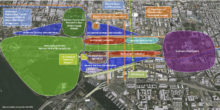
The bricks-and-motor museum, scheduled to break ground in 2012 and be completed in 2015, will be built at the intersection of 14th Street and Constitution Avenue NW. In the spring of 2009, a Smithsonian committee deliberated over six designs submitted by several high-profile architectural teams, including Foster and Partners and Moshe Safdie. That April, the committee selected a collaboration of The Freelon Group, Adjaye Associates, Davis Brody Bond and SmithGroup as the winning team.

The teams design features two inverted bronze pyramids that form a corona, or crown, meant to evoke an African headdress. The luminous crown tops a rectangular building with a roof garden, several overlooks and an open first floor.

The design stands in contrast to the classical white-stone buildings that form much of downtown Washington, yet the rectangular form and massing match the scale of surrounding buildings and are meant to not detract from the Washington Monument. When completed, the museum is expected to be the first building on the Mall certified for Leadership in Energy and Environmental Design.

The U.S. Commission of Fine Arts is fairly enthusiastic about the results of the competition, says Thomas Luebke, secretary of the commission. At the same time, its a very, very prominent site, so how the building is designed is going to have a huge impact.

Over the past year, several consulting organizations  including officials from the National Park Service, the Smithsonian Institution, the Commission of Fine Arts, and the National Capital Planning Commission, among others  have collaborated on two concurrent federal review processes that will affect the ongoing evolution of the museum.

In one review, a multiphased examination of the projects environmental impacts will address such issues as expected land use and visitation, the impact on natural and cultural resources, and ways the museum will handle vehicular, pedestrian and service-vehicle access. A concurrent historical review is scrutinizing the impact on historic properties surrounding the site, including the Washington Monument and other Smithsonian and federal buildings.

Once the site was chosen, our primary concern was and is to protect the integrity of the historic Mall but also to find ways to ensure that, if something is going to go there, it contributes positively to the experience on the Mall, says Judy Scott Feldman, chair of the nonprofit National Coalition to Save Our Mall, one of the consulting organizations.

The first phase of the environmental review, completed in 2008 by The Louis Berger Group Inc., addressed several key issues before the design process was even undertaken. The environmental impact statement found that the museum, in theory, would have little to no impact on the areas water resources, air quality, noise, existing visitation, infrastructure, and public health and safety.

The report acknowledged, however, that the museum is a major change in the land use of the Mall, particularly the Washington Monument grounds, and could significantly change views of that part of the Mall.

Since the consulting organizations began reviewing the project last year, similar concerns have been raised. David Maloney, the D.C. state historic preservation officer, for one, has asserted that the chosen site is not a good fit for a major national museum. Other people are concerned that the museum would block views of the monument and potentially interrupt the flow of a major national historic landscape.

The consulting organizations are now examining a series of revised design schemes put forth by the architects, recognizing that certain elements of the original plan  such as the corona  are inviolable, even if their precise appearance might change. The schemes offer varying footprints, heights, alignments (or not) with surrounding buildings, above-ground and below-ground spaces, and degrees of openness to the Washington Monument.

Feldmans group supports the idea of a plaza element in the museum or some other opening that can be a setting for public programs and encourage participation with the community at large.

Think of it as part of the lively open space of the Mall, since it will attract a lot of people, Feldman says. It should have an outdoor public open space that can be used for both museum programs and the Mall program. What the Mall needs are wonderful welcoming places where we can have outdoor activities.

As the design continues to evolve, the D.C. state historic preservation office and other consulting organizations insist that the building not mimic surrounding historic buildings simply out of a devotion to historicity.

We continue to reiterate the point that the site is not part of the Mall proper and should not become merely an extension of a rigid line-up of monumental buildings that relate only to the Mall axis and not to each other or to other features of the context, wrote Maloney in a June letter to the Smithsonian. Endless perpetuation of this model will stultify Washingtons urbanism.

To counteract this, the preservation office and others recommend that the design team develop a landscape plan and pedestrian circulation system that better connects the building to the Washington Monument grounds so its not just another duck in a historic row.

To this end, we believe the project would benefit from further conceptualization of the building and landscape as an entity, with consideration of the way users view and arrive at focal buildings, Maloney wrote. This could become both a practical and symbolic gesture on the approach to the Monument.

Although the consulting groups will continue to meet this year, and many decisions must be made before the design is final, Feldman is staying positive.

What if this museum became the catalyst for beginning outdoor, open-air programming on the Mall? she asked. It's accessible, it's in full view of the White House, and it could be a positive way to bring the city onto the Mall. Instead of being inward looking, we keep trying to think about what would be good for the Mall and what would be good for the city.

Kim OConnell is an Arlington-based freelance writer. She wrote about the redevelopment of the Lorton prison site in the winter issue of OnSite.