NCPC & public comment on National Mall Plan
December/03/2010 06:25 PM Filed in: National Capital Planning Commission | National Park Service
Dear Coalition Friends:
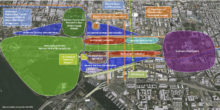
Yesterday, the National Capital Planning Commission gave final approval to the National Park Service's "National Mall Plan." There was testimony by six organizations including the Trust for the National Mall, National Coalition to Save Our Mall, American Society of Landscape Architects, National Cherry Blossom Festival, Downtown Business Improvement District, and The Committee of 100 on the Federal City.
Generally, these nonprofits welcomed completion of the plan and supported the goal of refurbishing and maintaining the landscape under Park Service jurisdiction. The C100 and Coalition spoke of the ongoing need for a more comprehensive, long-range plan beyond Park Service lands and priorities. ASLA urged NPS not to proceed piecemeal without a comprehensive design. The Downtown BID, Cherry Blossom, C100, and Coalition all called for more attention to affordable, low-cost transportation. ASLA stated its concern about a one-size-fits-all solutions to landscape improvements and encouraged use of more sustainable, permeable paving for walkways instead of the hard paved surfaces preferred by NPS. The BID pointed out the Mall also serves as a local resource and should be better integrated with the lives of residents.
Before giving final approval to the Plan, commissioners also commented on transportation, parking, sustainability, and the need to reach out to other Mall areas and constituencies.
Several commissioners (including DC's Arrington Dixon and Robert Miller, and Maryland presidential appointee John Hart) spoke of the need still for a larger coordinating planning effort for "the complete experience" that involves also the National Gallery, Smithsonian, and other Mall constituencies.
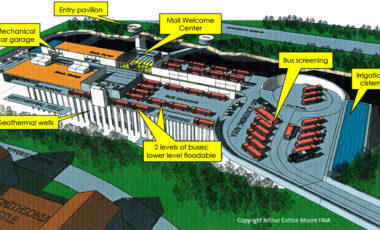
DC's Harriett Tregoning praised NCPC's collaboration with DC and federal agencies on the Plan, while raising concerns that Park Service contracting issues continue to stand in the way of improved low-cost transportation and the new Bike Share program. She said that gravel walkways are friendly to pedestrians but unfriendly to bicyclists, so keeping gravel is a way of keeping a pedestrian friendly environment. One glaring missing element in the Plan, she said, is tour bus parking, a long-standing problem highlighted in a June 2010 letter from Senator Jim Webb to the District and Park Service.
Rob Miller asked for a timetable for the Circulator on the Mall and was told DC and NPS are still working on it. He asked about consolidating public use permitting, which is handled by both DC Parks & Recreation and National Park Service, in a single system and location, and was told NPS would consider it. Would the revenue from parking meters on Mall streets, he asked, go toward low-cost transit?
Final comments came from Commissioner Peter May of the Park Service who said NPS would continue to talk with DC about Bike Share; agrees tour buses are a big problem (the Mall Plan dismissed any new parking options for buses or cars); found the idea of consolidating public permitting something NPS could look into but that it is "complicated." He said that on the question of a broader planning effort, the Park Service believes that has already been resolved, and he cited NCPC's Legacy Plan (1997) and Framework Plan (2010) as plans that already involved consultation with all the relevant federal and DC agencies (though neither of them addresses the Mall, but only areas surrounding the Mall). The vote in favor was unanimous. (Since this National Mall Plan is a set of broad concepts for specific restoration projects -- turf grass, refurbishment of Constitution Gardens, rebuilding of the Sylvan Theater, redesign of Union Square -- the next steps, once NPS has funds, will be to hire designers to flesh out the ideas into design concepts for public and agency review.)
What would a truly comprehensive, forward-looking National Mall Plan include? The Coalition testified that that Plan would include the entire Mall and all Mall constituencies -- including the Capitol grounds, White House grounds, Smithsonian museums, National Gallery of Art, USDA, District government, and the American public. It would look beyond preserving the status quo to the continued evolution and relevance of the Mall for American democracy. More of the American story could and should be told and this could happen by expanding the Mall's boundaries onto contiguous federal land to embrace new monuments, new museums, and new public activities. Such a plan would better integrate the Mall into the fabric of the District and the region, and provide a truly viable, functioning, affordable means of basic transportation around this vast 2-mile long landscape. It would establish a comprehensive, unified visionary plan, and coherent planning guidelines, for the entire Mall and identify how that plan could be implemented with unified governance.
Yesterday, the National Capital Planning Commission gave final approval to the National Park Service's "National Mall Plan." There was testimony by six organizations including the Trust for the National Mall, National Coalition to Save Our Mall, American Society of Landscape Architects, National Cherry Blossom Festival, Downtown Business Improvement District, and The Committee of 100 on the Federal City.
Generally, these nonprofits welcomed completion of the plan and supported the goal of refurbishing and maintaining the landscape under Park Service jurisdiction. The C100 and Coalition spoke of the ongoing need for a more comprehensive, long-range plan beyond Park Service lands and priorities. ASLA urged NPS not to proceed piecemeal without a comprehensive design. The Downtown BID, Cherry Blossom, C100, and Coalition all called for more attention to affordable, low-cost transportation. ASLA stated its concern about a one-size-fits-all solutions to landscape improvements and encouraged use of more sustainable, permeable paving for walkways instead of the hard paved surfaces preferred by NPS. The BID pointed out the Mall also serves as a local resource and should be better integrated with the lives of residents.
Before giving final approval to the Plan, commissioners also commented on transportation, parking, sustainability, and the need to reach out to other Mall areas and constituencies.
Several commissioners (including DC's Arrington Dixon and Robert Miller, and Maryland presidential appointee John Hart) spoke of the need still for a larger coordinating planning effort for "the complete experience" that involves also the National Gallery, Smithsonian, and other Mall constituencies.
DC's Harriett Tregoning praised NCPC's collaboration with DC and federal agencies on the Plan, while raising concerns that Park Service contracting issues continue to stand in the way of improved low-cost transportation and the new Bike Share program. She said that gravel walkways are friendly to pedestrians but unfriendly to bicyclists, so keeping gravel is a way of keeping a pedestrian friendly environment. One glaring missing element in the Plan, she said, is tour bus parking, a long-standing problem highlighted in a June 2010 letter from Senator Jim Webb to the District and Park Service.
Rob Miller asked for a timetable for the Circulator on the Mall and was told DC and NPS are still working on it. He asked about consolidating public use permitting, which is handled by both DC Parks & Recreation and National Park Service, in a single system and location, and was told NPS would consider it. Would the revenue from parking meters on Mall streets, he asked, go toward low-cost transit?
Final comments came from Commissioner Peter May of the Park Service who said NPS would continue to talk with DC about Bike Share; agrees tour buses are a big problem (the Mall Plan dismissed any new parking options for buses or cars); found the idea of consolidating public permitting something NPS could look into but that it is "complicated." He said that on the question of a broader planning effort, the Park Service believes that has already been resolved, and he cited NCPC's Legacy Plan (1997) and Framework Plan (2010) as plans that already involved consultation with all the relevant federal and DC agencies (though neither of them addresses the Mall, but only areas surrounding the Mall). The vote in favor was unanimous. (Since this National Mall Plan is a set of broad concepts for specific restoration projects -- turf grass, refurbishment of Constitution Gardens, rebuilding of the Sylvan Theater, redesign of Union Square -- the next steps, once NPS has funds, will be to hire designers to flesh out the ideas into design concepts for public and agency review.)
What would a truly comprehensive, forward-looking National Mall Plan include? The Coalition testified that that Plan would include the entire Mall and all Mall constituencies -- including the Capitol grounds, White House grounds, Smithsonian museums, National Gallery of Art, USDA, District government, and the American public. It would look beyond preserving the status quo to the continued evolution and relevance of the Mall for American democracy. More of the American story could and should be told and this could happen by expanding the Mall's boundaries onto contiguous federal land to embrace new monuments, new museums, and new public activities. Such a plan would better integrate the Mall into the fabric of the District and the region, and provide a truly viable, functioning, affordable means of basic transportation around this vast 2-mile long landscape. It would establish a comprehensive, unified visionary plan, and coherent planning guidelines, for the entire Mall and identify how that plan could be implemented with unified governance.