National Coalition to Save Our Mall
view  view         

Home  •   Search  •   Newsletter/Archive  •   Contact Us   


DONATE

ABOUT THE COALITION
LETTER FROM THE PRESIDENT
   October 2011

HISTORY AND RESOURCES
• Visitor Map & Guide DOWNLOAD FREE MAP!
• Illustrated History
• Future of the Mall VIDEO
• 1902 McMillan Commission   Report
• DC Monuments
• Access and Circulation

COALITION MALL REPORTS


NATIONAL MALL 3RD CENTURY INITIATIVE

National Mall Conservancy

ANNUAL REPORTS
• 2010 Annual Report (PDF)
• 2009 Annual Report (PDF)
• 2008 Annual Report (PDF)
• 2007 Annual Report (PDF)
• 2006 Annual Report (PDF)
• 2005 Annual Report (PDF)

GREAT MOMENTS
PHOTO GALLERY
• Who's in Charge?

THE MALL CHRONICLES
• Media Coverage
• Analysis
• Coalition Testimony
• Letters

THE WWII MEMORIAL
• WWII Memorial Archive

WASHINGTON MONUMENT
• Washington Monument Archive  Updated 8/26/2011

U.S. CAPITOL

THREATS & TREATS
ACT NOW
• What You Can Do
• Contribute

WHO WE ARE?
WHAT ARE WE DOING?
WWII Veterans
PRESSROOM
Detailed Search


The Mall Chronicles

Testimony/Comments

December 2, 2010

Comments on the National Park Service's Proposed New Security Screening at the Washington Monument

The National Coalition to Save Our Mall attended the November 8, 2010 public scoping meeting for security screening at the Washington Monument held at National Park Service administrative offices in East Potomac Park.  We were prepared to comment on the Park Service’s proposed alternatives, as well as to offer a number of serious alternatives to those proposed by NPS.  Since the NPS did not permit any open questioning and discussion during that session, we submit them now and ask that NPS respond seriously to our proposed alternatives.

The Coalition feels strongly that a major goal in any security screening solution should be to protect the look and simplicity of the iconic obelisk and its landscape as much as possible, and be fully reversible.   In our opinion, the alternatives proposed by NPS so far do not achieve those goals.  After commenting on the serious problems associated with the underground options, we devote the majority of our comments to what we believe is a promising alternative.  This alternative is a prefabricated, module security screening unit that can be inserted into the Monument’s doorway, a solution now being used by government and business in highly sensitive security environments.   This alternative would avoid any adverse visual impacts on the Monument and its landscape, be far more cost effective than the underground solutions, be friendlier to visitors by allowing them direct entry through the Monument’s door, and be entirely reversible.  We strongly urge NPS to undertake a serious study of this option.

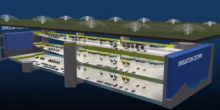
The NPS proposes to replace the existing temporary screening shed with a number of underground/below grade structures that would provide a new entrance to the Monument, and one alternative of a new glass above-ground structure.  We wonder what the program is for these alternatives, all of which appear to be considerably larger than the existing screening structure that has performed the necessary function for seven years.  We request that NPS provide additional information about the need being addressed and the scope of the program.

Major adverse impacts and potential threats to the Monument’s foundation from all underground alternatives

The most serious concern is that all of these underground options will require cuts through the Monument’s concrete foundation to provide a new public entrance into the Monument below grade.  The long history of engineering concerns about the Monument foundation’s integrity, dating back to the 1880s, should raise red flags about this approach. 

The NPS is well aware of this history, yet during the November 8th meeting there was mention of the foundation history but no discussion at all of the fact that everyone from Colonel Casey in the 1880s to Congress in the 1930s rejected projects that might jeopardize the stability of the foundation.  Based on that history, and with no additional scientific data to show that cuts through the foundation are feasible or wise, these options should be rejected outright as no serious alternative at all.  The 2003 geotechnical study NPS says is its guide does not even address cuts through the foundation, but instead focuses on the soil conditions around the Monument.   The notion that the NPS as steward of the Monument would put on the table this option seemingly without any new studies to support its safety, or concern for this long history of caution, is shocking and unacceptable. 

Anyone with knowledge of the recent past has to wonder if this underground concept is just the latest in a series of underground visitors centers NPS has been proposing to build at the Monument, in one form or another, since the 1960s – and which Congress has never supported with funding?  It certainly would seem to be.  How else to account for the large size of this proposed structure except that it is intended to also hold visitor services, retail, restrooms, and so on?   Far from reversible, the cuts into the landscape and related additions of new walkways, handrails, and so on would create major, permanent adverse impacts on the landscape and visual intrusions on the simplicity of the Monument itself.

Another alternative that minimizes any adverse impacts on the Monument, is visitor-friendly, and is totally reversible

None of the NPS design concepts investigates solving the screening problem inside the Monument shaft, and approaching the entrance directly from the existing flag-ringed plaza.   This is an alternative presently being utilized by federal government in high security situations that we believe merits serious study.

A module screening unit could be installed inside the Monument doorways to screen visitors as they move through the 15-foot-thick walls from outdoors into the elevator waiting area.  One example is that produced by IsoTec Security but there are probably others.   We have been told by IsoTec representatives that custom units could be created at only a fraction of the cost of the other NPS options.   The IsoTec website provides details at http://www.isotecinc.com/ .

This system utilizes a customized bullet proof glass enclosure (one example measures 36” x 84”) with doors at both ends that allows several persons at a time to enter, screens them, and releases them out the opposite side when they are cleared. The process is automatic unless the individual is carrying controlled material, at which point a guard is alerted.  The entrance door can also be used as an exit.  Or, consideration could be given to re-opening the Monument’s west door that was closed in the late 19th century to be used as an exit.

The advantages of this system are clear:

  • The ticketed visitor proceeds, on level, directly from the open air into an indoor holding area sufficient in size to accommodate the capacity of the existing elevator cab
  • No exterior construction is required except repairing the area of the demolished existing security structure
  • No excavation and cutting through the foundation of the monument is required
  • The project from beginning to full operation can be accomplished within 60 days
  • The equipment has the built-in capacity to be readily adapted to meet any type of security threat that becomes current, with a minimum of down time
  • There is a significant reduction in both design and construction cost. It is fully reversible

At the November 8th public session, we mentioned this option to the Acting Superintendent who stated all such options had been considered and rejected.  If the IsoTec type unit has in fact been rejected, we request NPS explains in writing the reasons for that rejection of this alternative.

For the National Coalition to Save Our Mall,

Judy Scott Feldman, Ph.D.
Chair and President

W. Kent Cooper FAIA
Vice Chair


Back to the top

ANALYSIS & COMMENTARY
• Coalition offers alternative for NPS "temporary" building
• Needed: A National Mall Conservancy
• Changing Face of the National Public Space
• Memories & Mishaps
• Dead End for the Freedom Trail?
• This Singular Space: Against the Memorial
• Media Coverage & Commentary
• Public Testimonials
• Mall Watch
• Additional Resources on the Web
  and more ...

TESTIMONY/COMMENTS
• December 2, 2010, Coalition testimony before the National Capital Planning Commission regarding the National Park Service National Mall Plan
• December 2, 2010, Coalition comments on the National Park Service's proposed new security screening at the Washington Monument
• November 2, 2010, Coalition submits questions to NCPC
• August 19, 2010, Coalition comments on NPS "temporary" building
• May 30, 2010, Coalition comments on the proposed Environmental Document for the Dwight D. Eisenhower Memorial
• April 8, 2010, Coalition comments on NPS Turf Plan
• June 4, 2009, Latest comments on Vietnam Visitors Center
• May 26, 2009, Nonprofits comment on Park Service "National Mall Plan"
• May 26, 2009, Park Service responds to nonprofits' May and Dec 2008 joint letters
• March 26, 2007, NPS Mall Plan: Additional Comments by the NPCA
• March 12, 2007, NPS Mall Plan: Comments by Save Our Mall
• January 15, 2007, NPS Mall Plan: Comments by Guild of Professional Tour Guides
• December 26, 2006, NPS Mall Plan: Comments by the NPCA
• August 3, 2006: Vietnam Veterans Memorial Center project
• October 6, 2005: Vietnam Veterans Memorial Center project
• July 21, 2005: Commission of Fine Arts on Lincoln Memorial Security
• April 12, 2005: The Senate Energy and Natural Resources Committee Subcommittee on National Parks
• March 17, 2005: Lincoln Memorial Security/ CFA

LETTERS
• April 12, 2005: The Honorable Craig Thomas, Committee on Energy and Natural Resources, United States Senate

MEDIA COVERAGE
• Washington Monument Security
• World War II Memorial
• Vietnam Veterans Education Center
• African American History Museum
  and more ...

Copyright © 2010 National Coalition to Save Our Mall Inc. All Rights Reserved